SOME OF MY WORK
"Create to conquer the pain." ~ Isabella Xochitl Ordaz
✳︎
"Create to conquer the pain." ~ Isabella Xochitl Ordaz ✳︎
“Profile Pic” by Isabella Xochitl Ordaz
September 29, 2026 | Thoughts Inspired by the Decision to Update my Profile Picture
During the emergence of social media as The ubiquitous surveyor, I learned as a preteen that my Public self is separate from my real self. I educated myself on the methodology of creating a Self by consuming copious Youtube videos produced by intelligent, talented WoC bloggers who explored beauty and life-style. By the time I graduated high school, I fixated on developing a personal brand that would help me not only define my voice, but also inspire other young women of color.
Upon entering college, I decided to carefully curate a Brand of myself online to optimize my opportunities as a first-generation student. I studied what others at my school were doing to perform social markers that standardized our experience. A lot of my Facebook history documents the process of attempting to trail-blaze a unique and somewhat radical voice amidst this standardization.
Roughly around this time ten years ago, I shared a picture of myself delivering a TEDxTalk along with a link and long description of my gratitude for the opportunity. It garnered a considerable amount of attention within the context of my Pepperdine social media experience; this exposure, along with my online campaign for a student government position, seemed to land my face on a lot of people’s timelines and before long, as a sophomore, I felt like I was greeting every other person I ran into on campus. I had become Seen in a way that I wasn’t used to.
While the sensation of being enclosed in a bubble certainly popped within the last 8 years since graduating, I still am confronted with a panopticon-like experience while using Facebook. This is the case despite it seeming that many of my contemporary peers do not regularly use this platform— at least, not in a visually measurable way.
In a recent conversation published on Youtube, Angela Davis encourages the audience to SHARE their activism within a collective context. I generally keep most of my thoughts to myself because I’m mindful of the facts that 1) I’m still growing intellectually and 2) our data is no longer “ours” when we share on Meta platforms. However, I am here and I just want to say that I think I’m no longer too afraid of Big Bad Tech (which is a topic for another essay!), or even a perceived audience.
What are your thoughts?
Peace,
Isabella XO 🕊️
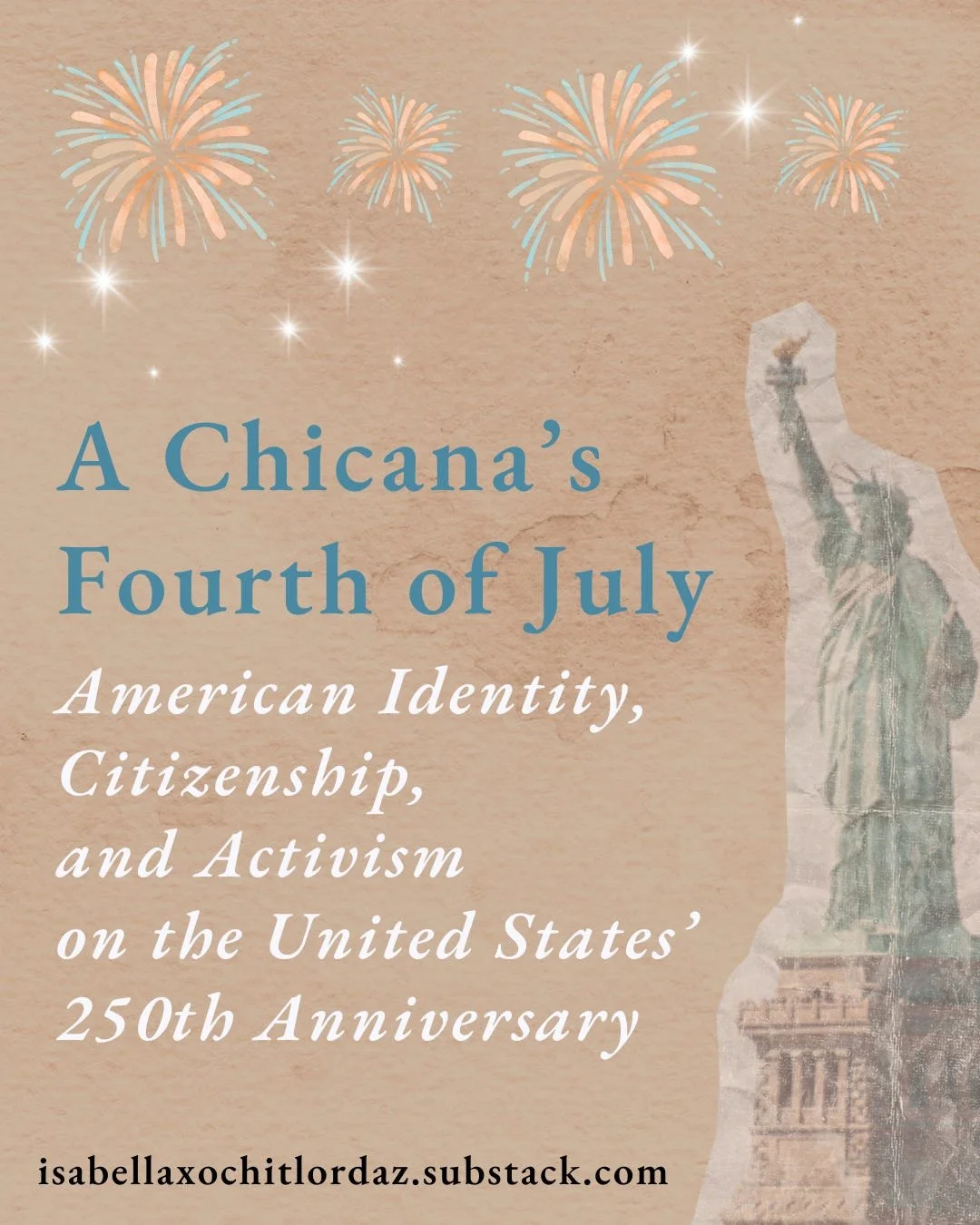
“A Chicana’s Fourth of July” by Isabella Xochitl Ordaz
July 4, 2026 | American Identity, Citizenship, and Activism on the United States’ 250th Anniversary
In my earliest memory of celebrating the Fourth of July, I’m getting dressed by my mom in a red, white, and blue outfit from Old Navy. You have to wear red, white, and blue on Fourth of July, my mom told me. She dressed me in a dark red spaghetti strap tank with a little American flag at the top center, and along with a pair of white denim shorts. We were spending time with my mom’s side of the family that day, and I was excited to see my cousins and aunts and uncle; my mom’s side always felt a little less aggressive and more female-oriented than my father’s side.
We ate carne asada, hot dogs, and enjoyed ice cream from maybe Baskin Robbins or RiteAid, where we always got our ice cream. I set off fireworks with my brothers (fireworks we probably shouldn’t have had access to as young kids) that my family bought on the side of the road from a TNT vendor. My dad and other adults enjoying Corona cervecitas, the boys sweating while playing basketball in the backyard of our Antioch home, the concrete ground hot from the sun and pelted with rotting fallen peaches from our neighbor’s peach tree… this is the sort of celebration-- a vacation from a day of being a working-class family-- every kid in the United States deserves on the Fourth of July.
So, how am I supposed to celebrate this year knowing there are children and their families who are detained by the United States government spending this holiday locked up in inhuman centers because they came from the same Latino America my family is from? These are children who look just like what little-me looked like over twenty years ago-- running and jumping and listening to stories from their elders. I doubt that today they can play with the same sparklers and popper firecrackers I once did.
How am I supposed to celebrate this year knowing that Black Americans and other people of color are being targeted every day for existing in a state of mass surveillance and incarceration? How am I supposed to celebrate knowing that while European-Americans gained sovereignty from Britain in 1776, it was dependent on conditions in which humans were enslaved, tortured, exploited, and hunted as though they weren’t human?
I feel particularly conflicted about celebrating when just a few days ago the nature of my citizenship was in question, given my birth in the United States to undocumented immigrants. Practically half the country, our “leader” especially, doesn't believe I belong in a very fundamental way. This threat, however, goes beyond neo-liberalized discourses of diversity, equity, and inclusion-- this impacts not just my own material, political, and practical sense of security, but the safety of all folks like me.
The conservative zeitgeist against immigrant communities does not surprise me, but it nevertheless chills me. Not too long ago, when ICE was in Oakland, I heard citizens were being profiled and detained; I was scared to leave my apartment near Downtown and avoided any activities that required me to leave my street on a particularly impacted day. That week, while walking to and from the yoga studio I was getting trained at down the street, I was hyper-vigilant while trying to attract as little attention as possible, walking quickly and avoiding eye contact.
Listen, I’m no victim. I’m hardly even a survivor compared to what other folks have experienced at the hands of the American empire. In the words of Beyoncé, America truly has a problem, despite the egalitarian ideals of democracy and opportunity I learned about in grade school.
The problem with American democracy is not necessarily the philosophical ideals that seminal political thinkers dreamed of the United States manifesting; it’s the fact that while thinkers like Thomas Jefferson were writing the country’s founding literature, they were also actively exploiting enslaved and colonized people they did not consider fully human, depending on systemized and interpersonal violence to achieve their aim of building the country. Recognizing the “other” as human and entitled to the same exact rights was outside of the scope of not only their political imaginations, but also their spiritual ontologies. The material conditions under which they formed the construct of American democracy create a fundamental blockage for genuinely and radically manifesting democratic ideals.
I acknowledge condemning men buried over hundreds of years ago is an old and beat argument at this point, but I find power in re-imagining foundational theoretical positions. Beyond respect for social difference (whether it be economic, racial, gender-based, etc.), a more justice-centered approach for outlining American democracy would incorporate room for restorative and reconciliatory efforts when egregious errors are inevitably made due to the fallible nature of being human. Nevertheless, it is with little hope that I wish for a refresh in our nation’s seminal literature.
Where I find the most esperanza, hope, is rather in the reconstruction and transformation (through sociopolitical theory and activism) of the material conditions the marginalized are given. These efforts are led by not just my favorite scholars like Angela Davis, bell hooks, Robin DG Kelley, and Michelle Alexander, but also by everyday participants in online and in-person discourses of liberation. I also firmly believe in the space of education, particularly colleges and universities, as a laboratory for critical study of and rethinking Nation.
“Where I find the most esperanza, hope, is rather in the reconstruction and transformation (through sociopolitical theory and activism) of the material conditions the marginalized are given.”
In his 1955 essay collection Notes of a Native Son, James Baldwin writes, “I love America more than any other country in the world and, exactly for this reason, I insist on the right to criticize her perpetually.” While I cannot now say I love America, I do resonate with Baldwin’s personal investment in the country and insistence on an ongoing relationship of rigorous criticism with the United States. I think ultimately all we can ask of ourselves is to 1) take care of ourselves as an act of political warfare (Audre Lorde) and 2) question everything.
Today, I celebrate, identify with, and honor all the thinkers and activists who came before me to build out the American national literary landscape of love, study, and struggle that inspires me to my indigenous Mexican bones. I’m Mexican-American, American in the “Radical-Dissident-Freedom-of-Speech-Democracy-Loving” sense. In other words, I’m Chicana. I cherish my rights and find gratitude in all those who struggled and suffered to ensure I had these rights, praising God who gave them the strength to carry on. I don’t take my privileges for granted.
Today, I’m also hanging out with my cousin, his friends, and a guy who I think is cute. We're going to go see fireworks at the Golden Gate bridge from Crissy Field Beach. I have my outfit planned, and no, I’m actually not wearing red, white, or blue.